DIE RPG The Roleplaying Game
by Kieron Gillen & Stephanie Hans
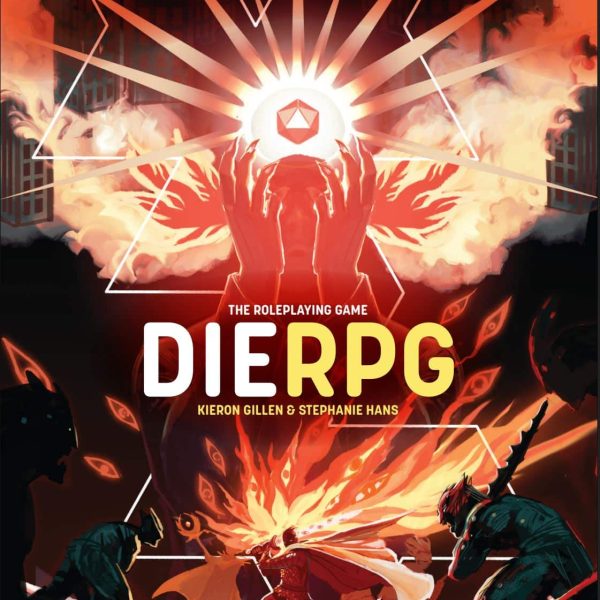
Scrutinizing the Secret Sunday Sampler1 - part of Quinn's Quest Knowledge Knight Review Jam #1
The GM Perspective
I love running Die in all its forms for newcomers to the game or comic. This was my second attempt at running any game in the Quinn's Quest server, shortly after joining, and the response was incredibly exciting and excited.
DIE RPG is a game in which you play as messy adults who used to be in a game together as teenagers; it has been several years since, and you meet again for a new, different game - which transports you to a version of the fantasy world you used to share, with exciting and scary new powers. The group can leave this fantasy at any time, but all of them - all of you - have to agree at the same time to do so. That includes the person who brought you into Die in the first place…
The session specifically used the 'Total Party Kill' set-up from the core book, designed to fit single, one-shot sessions:
You all used to play fantasy RPGs together as teenagers, until an awful session where the GM threw you into a killer dungeon and slaughtered the party. Now years down the line, you’re all back in town and the GM suggested a game. With mutual recrimination, both in and out of game, you’re surprised they asked. You’re perhaps even more surprised you all said yes.
Including me - as the GM has a character and stakes in the game too - there were four other players.
The Good
I have gushed about Die as a game since it came out in its current incarnation,2 but one of the major strengths of the TPK scenario is the advice it gives on how to run the game in one-shot mode. This breakdown by Gillen is unparalleled by any other game I have encountered so far:3
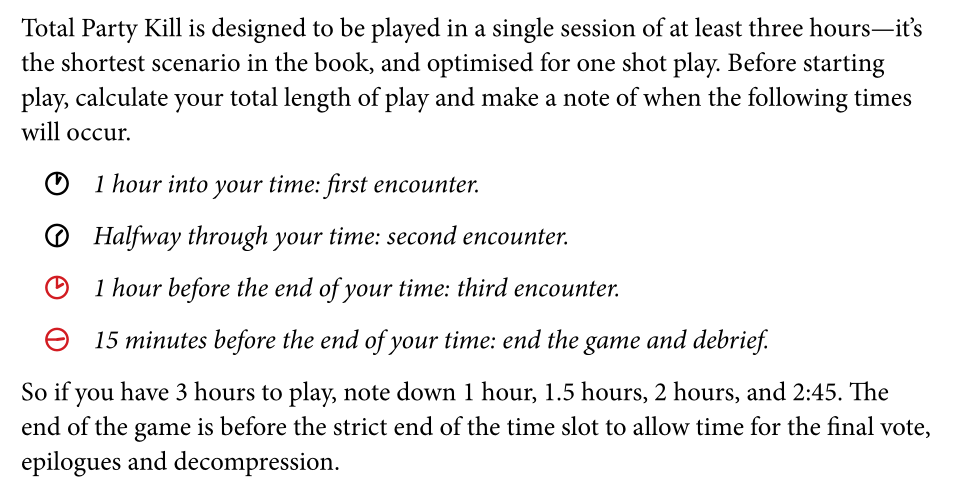
This, along with the many other tools that Die offers,4 makes the GM look like a maestro of pacing and timekeeping, as well as facilitating the story. The encounters happen exactly at the right moment. The climax comes specifically when things couldn’t get worse. It’s a joy seeing a game sing so well every time I get to bring it to a table.
Character creation - an ongoing process that sets up a web of relationships between the Personas (player characters), with the GM's character at its centre - is a rushing river of twisting knives and rubbing salt in wounds, as the past is established and the present is affected by it. All of it is guided by leading questions, and it continues throughout the game, as new scenes, encounters, and NPCs appear.
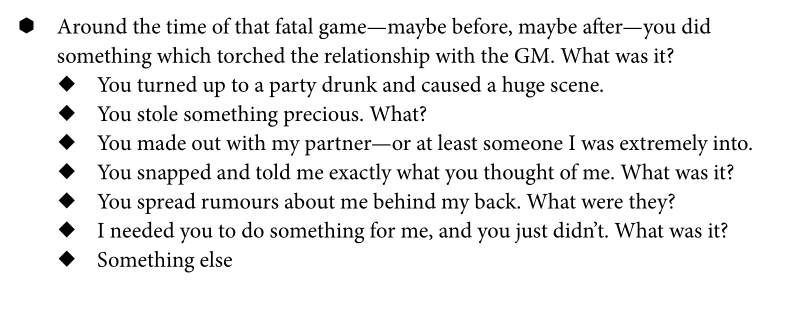
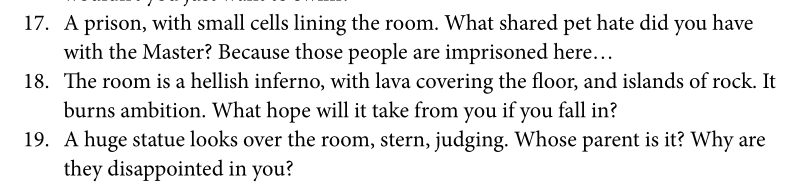
The session culminates in a final confrontation with the Master - the GM's character - as they are trying to force their way into the fantasy world forever. It doesn't work: the rules apply to all players, the choice must be made together. Backstabbing, tears, appeals to humanity ensue.
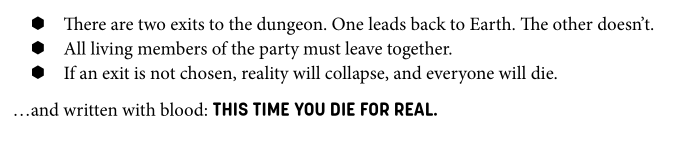
In this particular session, my character was eventually killed by his need to keep cheating at the game. Everyone else chose to stay in the fantasy world forever, but it was very close.
The Bad
Die tells one story, and it does so extremely well, every time. It does not tell a range of stories, a selection of stories, a variety of stories - it tells one (1) story: messy adults playing a game to escape their life, and bringing back old troubles, now in fantasy form.
This is not exactly criticism, as it's not a failure of the game. The focus is an intentional limitation,5 and something to keep in mind when trying to use it for any other kind of game. You can play Die in a variety of modes and settings, but the story you will tell is the one it sets out to tell. System very much matters, here most of all.
That said: despite the excellent timing advice for the one-shot scenario, Die truly shines in its Rituals form (4-6 sessions of play). Persona generation can take a lot more time, and allow for more nuanced and messier connections. More choices can be made by the players about their characters in the fantasy world (Paragons). There is nothing I would change about the single sessions I have run, including the ones in QQ, but they exist within the knowledge that TPK is just an amuse-bouche - I will just have to play more with the same people to savour the full experience. All games are canon.
The Noteworthy
Interest in the game was big enough that I ran a second session for UK/EU timezones shortly after the first was arranged (May 2026), and then again another session later in the year (August 2026) for some of the players who had originally signed up and weren’t able to make it. My mission to spread Die across minds and hearts continues to succeed.6 Remember: all games are canon.
The experience also fostered some close connections with the players in the games, to the point of having met in person at least two of the players from that first game, and one from a later session; the others haven’t happened yet simply due to geographical limitations. There is still one more session to be planned, as the appointed date and time eventually turned against us, so I expect that to happen in October. All games are canon.7
Bonus track: player commentary
Adrian
DIE RPG is fucking good, like viscerally good. The character classes are insane and really get deep into different archetypes of TTRPG player and characters?? (the meta discourse has started I don’t even know how to name stuff).
I think the one-shot scenario is a really good preview for the full game, I really liked to see our group having trouble and conflicts and how shitty every character got. Also getting to mess up the GM character inside the game is a super fun opportunity.
I was already really interested in the game and comics (and by the way the art is so cool), but after playing I really want to try the full game. I’m beyond hyped for the Metadungeon.
Otavio
The creation of a real world person as the first step to DIE, and of their ties with the rest of the party in the real world was so much more powerful than I expected. I didn’t realise how close to home things said and done would hit when I saw my character as a normal person (and thus could expect similar reactions from them as mine), in a way that is less true when you are a powerful hero, or even in just a fantasy setting. This was the real world with real problems. Once that was established and that view had been established, changing context and going to the game world, gaining power didn’t really change things. I was still human. I am always someone that feels less comfortable in the ROLE-playing side of things than in the ROLL-playing side, so I was amazed at how much this little trick from DIE helped me get into it. I still have very clear memories of being an annoying ass to my Brother in the game, and having done so out of pure reflex and brotherly spite. I wasn’t expecting that from RPG Jumanji: the Game,8 and yet, here we are.
Gemelli
The story that the DIE RPG tells is very, very good. Part of the trick is that it forces you to acknowledge the overlapping bits between player and character that are always somewhat inherent in RPG play, and having you engage with that premise at one step away feels a bit like you’re watching a magic trick. Deciding whether your character holds on to the flawed Real World incarnation of themselves, or wants to embrace the escapism and dive headfirst into the fiction, is a provocative bit of character building every time. That said, the story can be exhausting – for me at least, a few hours of confronting traumas, difficult truths, and self-reflections that don’t always end up where you expect can be a lot. But if you can dig a little deep and engage with the story where it lives, this game can absolutely deliver unforgettable experiences.
"A consistent open table to try out new systems, run play tests, and generally have a great time with other members of [the Quinn's Quest] discord."↩
I did not play its various beta incarnations, though I almost did once. In fact, my copy of Die RPG was a gift from one of my first players of the game. How things have changed.↩
Of all the games I've played, the only one that struck me in a similar way has been Cloud Empress.↩
One of my favourite parts of the book is on pages 178-181, 'Adventure Structure'. This is second only to the 'Bestiary', which is, among other things, an exercise in comparative fantasy bestiaries based on LibraryLass' work.↩
Limitations breed creativity, or something.↩
If you flick between the different spotlight reviews on the RRD website, you will find mine is the one chosen for Die.↩
"From Die's perspective, the games are all prey." p. 5.↩
We call it Goth Jumanji, mostly.↩