PRISM
by Fumble GDR / Claudio Pustorino1
The Pitch
You are Anomalies, people who exist, live, and struggle within the horrors of a dystopian society. Around you is a crowd of Compliant, who believe that the Authority is actually protecting them from the Threat they claim is a danger to you all. One of you is the Dystopia. Your stories can take place in a number of genres, ranging from cyberpunk to near-future realism, to more outlandish sci-fi or post-apocalyptic rebuilding, even inner mindscapes of a single individual, but the core tenet is the same: you're meant to face your fears and eventually, maybe, overcome them, as the dystopic systems of power around you exert control.
The Experience, in Brief
- Ran twice, but one time specifically comes to mind.
- Currently only exists in Italian; I translated on the fly when I ran it for English speakers.
- My pitch for the game was: "Swaggerson's plan has come to fruition, now the Forcekeepers run this place. You're an Anomaly, living in what once was a place for community. Face your fears, make hard choices, explore the Dystopia of... Terminal City."2
- Ideally I would have done some shared world building as well as the character creation, but the game circumstances (convention game) made it so I had to speed up the start a little.3
- For anyone curious, and with some Italian, there's a full tutorial and teaching playlist of videos.
- The Shades are expansions to the core premise of the main book, covering other genres, and are still in production.
The Really Good Bit
It feels a little like cheating to point to the core mechanic of a game and say that it's the Really Good Bit about a game. A game, however, of course, is not entirely its core mechanic, so I feel justified in resuming my pointing at what PRISM does in a way that fascinates me: Labels (etichette, in Italian4).
Labels are traits, characteristics, defining aspects of the Anomalies, the player characters (or player groups, you don't have to play as a single person if you don't want to). Specifically, you start the game by defining nine Labels: one for your Anomaly's name, seven for additional aspects, plus an additional negative one, an Adversity. The Labels themselves can be a single word or a short sentence, and describe the Anomaly exclusively or their connection to the world around them, in the form of other people, organisations, ties, activities.
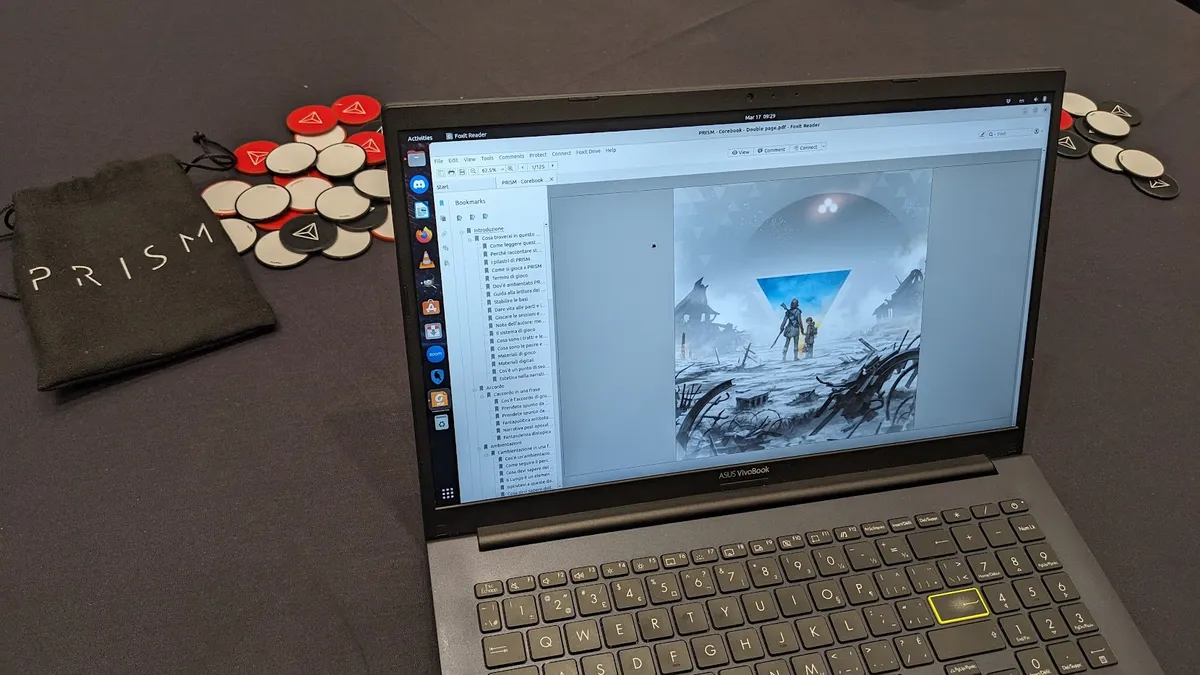
This pool of Labels - written out on tokens, or pieces of paper, or cards - will then be used for every check during the game, but already from the start, the Anomalies have full narrative control over the setting, its inhabitants, the nature of Compliant and Anomaly alike, and help define the shape and edge (and scope, even) of the Authority.
Unbound, by Grant Howitt and Chris Taylor (art by Adrian Stone, layout by McJanda) feels in conversation with PRISM, in that both games make use of player choices for abilities, powers, and defining features to inform and shape the setting of the game itself, from the very start of the first session. Amusingly, Royal Blood - also by Grant Howitt - reminds me of a variation of the second part of the PRISM mechanic: using the Labels extracted during a check (or Facets wagered, in the case of Royal Blood) to narrate the scene as it resolves and develops.5
Because that's the second half of the Really Good Bit I am still vehemently pointing at: when an Anomaly attempts to do something that doesn't have a certain outcome, they place as many Labels as they deem relevant to the situation, plus blank Fear (player's choice, 1 to 3) and Danger tokens (GM's choice, 1 to 4), in a bag, and draw three back out. They can push, and draw up to three more, too. If there are positives in equal number to the difficulty (agreed upon before hand, from 1 to 4), the check succeeds. Dangers, adverse traits, and blank fears do not count for succeeding at the check. But crucially: the Labels extracted, regardless of success or failure, are used to describe, one by one, how the scene develops. Using the words written on the Labels, players suggest, define, and determine how the world reacts and responds to the Anomaly's actions; the Dystopia narrates the Dangers and Adversities, the Anomalies narrate everything else.
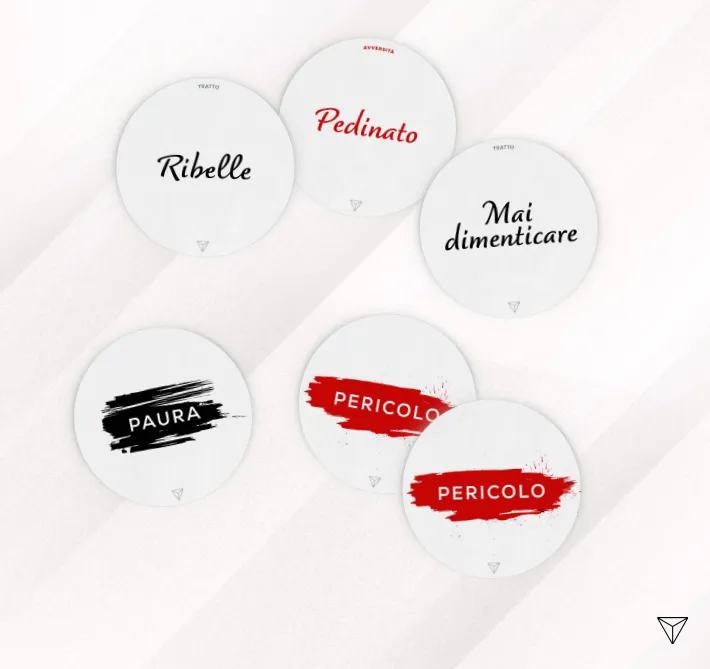
Take for example the image above, from the core manual: the draw resulted in two traits, an adverse one, a fear and two dangers. On a difficulty of 2, this would succeed. Anything higher, it won't. The Anomaly might narrate how being a Rebel (ribelle) means they have access to ways and means to defy the authority trying to pin them down, they've been doing this for a long time; the Dystopia might retort that being a known rebel will lead to, if not them, someone else hurting on their behalf, out of spite or to get to the Anomaly - one of the blank dangers becomes a new adverse trait: Collateral, or maybe They Hurt for You; which will trigger the Never Forget (mai dimenticare) trait, either as direct consequence, or as pre-existing knowledge that this is how the Authority operates and moves, and the Anomaly was prepared for it, erasing their contacts and making sure everyone was not in the usual spaces, sparing them this time. The final trait (all of them have to be played) the Dystopia has left to narrate is Followed (pedinato): the Anomaly and their contacts might be safe for now, but they know that the Authority knows, they know that they're not safe for long, and that someone is on the way; this also triggers the blank fear token left, which turns into a new trait, as the Anomaly describes how the fear of losing everyone (maybe again?) makes them a Planner. They have this under control. The final danger token will be used to mark one of the traits, which is how Anomalies change and evolve through the game, and something I will not spend more time describing here.
It's a deceptively simple engine that prompts Dystopia and Anomalies alike to come up with narrative framings, bouncing off each other, asking for help from everyone at the table to make full use of the Labels. It leads to fully immersed scenes and engaged players, as everyone keeps building on everyone else, with nary a number in sight. PRISM's core tenets apply to both the narratives it facilitates and the game its engine runs on: Affronta la paura, fai scelte difficili, vivi la distopia.
Face your fears, make hard choices, explore the dystopia.
PRISM only exists in Italian at the moment, and there are no plans to translate it into English.6 It is, however, by the same team behind Green Oaks, so never say never!
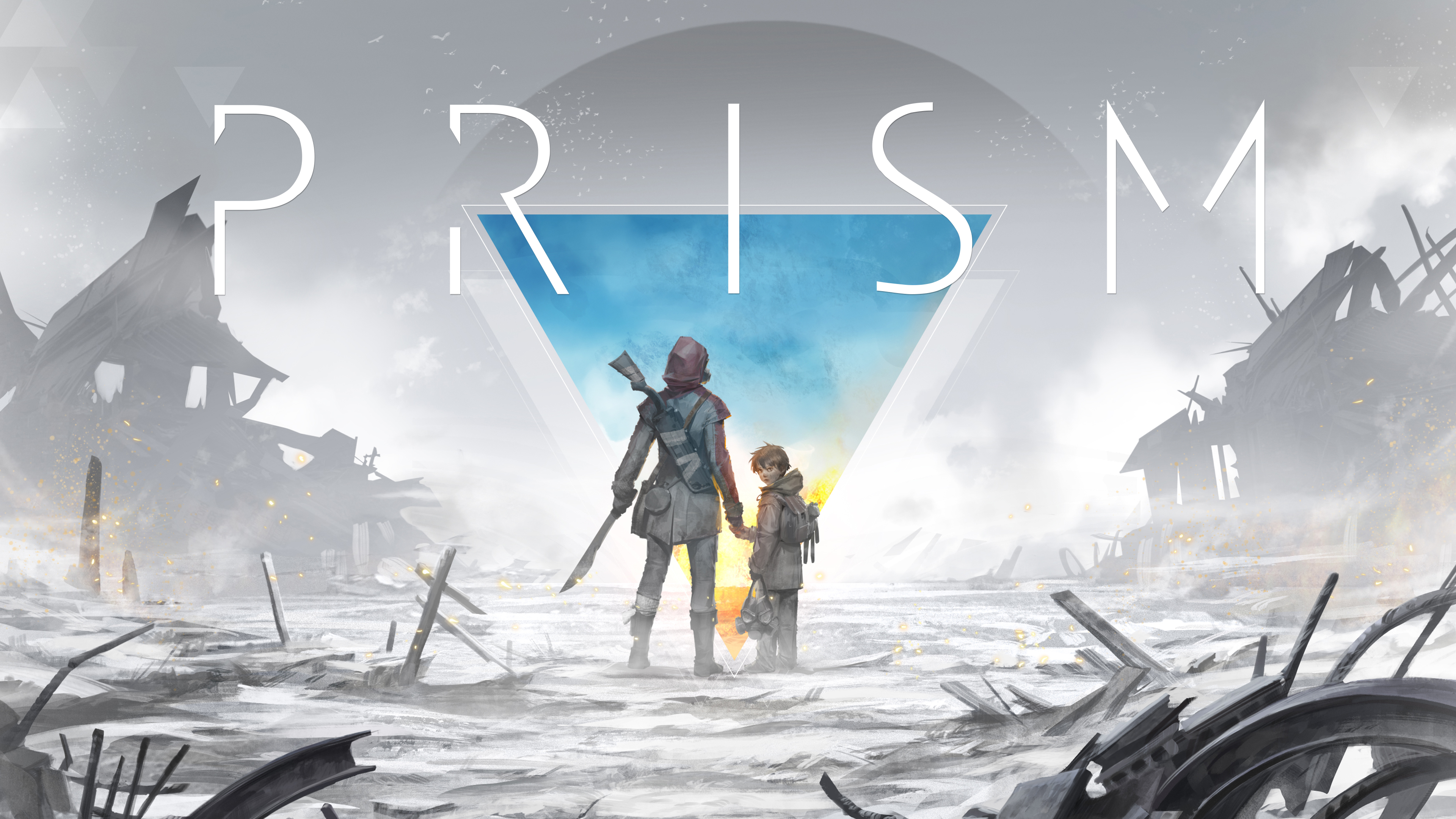
All the art in the book is stock images, except for the cover; the artist is Daniela Giubellini, of Two Little Mice.↩
Any resemblance to cities or people in the real world are entirely intentional.↩
Turns out that when you schedule a game for 9 am on the last day of a convention, and mostly your friends sign up, you might end up driving everyone to your game, and some prep gets done in the car.↩
I subscribe to the school of thought that you should not have to italicise "foreign" words in a text.↩
It really amuses me, personally, that the next game by Pustorino - Not the End - was published by Mana Project Studio (also available in English), who provided art and the Italian edition for the remastered Royal Blood. This industry is a stack of flat circles.↩
The original crowdfunding campaign, from March 2023, was to produce the book and raise funds for La Gilda del Cassero, the queer gaming space in Bologna.↩