NOVA
by Spencer Campbell/Gila RPG
The Pitch
An alternate timeline in the near-future where the sun has exploded, damaging the moon and Earth as a result. To survive, humanity has harnessed the power of the solar shards and sunwells scattered across the planet, and push further and further beyond the safety of the communities rebuilt around them. To do this, we created exosuits that use the same solar power, tools to defend, attack, and withstand the threats of this new, darkened reality. We call them Sparks.
The Experience, in Brief
- I ran NOVA three times, with different groups, a couple of sessions each, with a varied choice of player characters between games.
- The game's rule framework is light enough that it allows people to get into fun "optimised" builds or purely narrative and/or aesthetic vibes.
- The art by Eddie Yorke, for both Sparks (player characters) and enemies, is an excellent hook for players; the layouts by Julie-Anne “JAM” Muñoz were an even bigger hook for me as main reader of the book.
- Despite having played multi-session games, they were all centred around the same mission; I'd be interested to see a longer mode of play, and how it affects the Sparks and their modular design and upgrades.
The Really Good Bit1
This is not a review of the game as such. I am not interested in selling the whole game to anyone reading. I am interested to show the one thing I am incredibly excited about the game,2 and the aspect of it that I keep thinking about since playing. The one good piece of game design that has grafted NOVA onto how I think about other games3 when I play them: Moves.
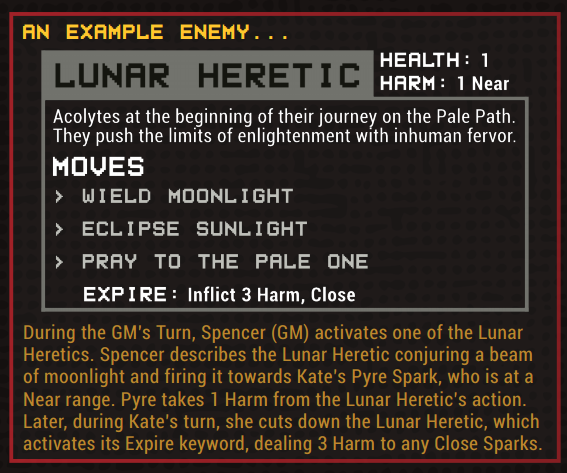
Moves, in NOVA, are ways to flavour an encounter, or behaviour of a character, that - at its core - uses the same basic idea and mechanic every time.
A Move is just the name of a type of action an opponent might take, but the "mechanic" is unvaried. In the Lunar Heretic example above, you have "Wield Moonlight" or "Eclipse Sunlight" or "Pray to the Pale One" as three distinct types of Move; each of them, regardless of the action, deals 1 Harm. That never changes. What changes is that the GM is encouraged to use the Move as a narrative prompt, flavouring the action, modifying the way the fight looks (because these are fighting words) and behaves in response to the players' actions and the enemies' response.
The mechanic, at this stage, is entirely in the hands of the players, who are describing their approaches and movements based on their resources, without rolling dice. It's a simple trick, but one that reinforces its own framework each time, and one that needs no additional rules, or tags, or modifiers.
And it's not just for characters, creatures and other NPCs. It's for locations too:

In one of my games, the players were exploring the Dusk and found themselves in an abandoned mining shaft (Structure) of sorts, leading to an old, underground city (Structure), the current base of a corrupted Spark. The Theme I chose was Pale, so the place itself was filled with Deceive and Enchant moments, the two prompts that informed my narration and management of scenes all the way down to the city itself.
I didn't have to prepare any of it, the Themes reinforced themselves. Any time the players caused the world to react, or an opponent to respond, anything shifting in the scene at hand, NOVA was ready with the inspiration. It doesn't tell you what do, it suggests how you might do it.
Suit up. It’s time to bring a new dawn.
NOVA is getting a second edition soon, supposedly using the LUMEN 2.0 system, which means it'll go entirely diceless like its (at the time of writing) sequel NEST.
While I am not stealing this concept from a Kieron Gillen post about games, I realised while writing the structure of the review that I am doing something very similar. He's influential, that Kieron.↩
I was, in fact, inspired by this excellent manifesto from Seraphina. This post did indeed start as a message in a Discord server.↩
What inspired me to write about this specifically was a conversation I saw months ago in the Bastionland server, which I then carried over into the Quinn's Quest server too. In that case, it was about Omens in Mythic Bastionland, and the criticism was that they felt underbaked as encounters, rather than - as I see it - suggestions and ways to flavour encounters related to their respective Myths.↩