GOING FOR BROKE
by Avery Alder

The Pitch
You're one of twelve possible housemates in a precarious, queer, messy household, each with driving personality trait and defining interests. You're also, all together, directing your group of housemates through two parallel plots of a sitcom episode as showrunners, hoping that at least one of the plots will succeed at making rent (or whatever the major expense this "episode" might be).
The Experience, in Brief
- Backed it early on, and played it on the day it arrived, then again a few months later.
- Very fast to set up, very fun to riff on each other's scenes, works best if you play some actual sitcom music.
- The rules are not included in the mini-pack of cards, but are both free online and downloadable. They don't take long to internalise, either.
- The second time playing we strung together two scenarios to fill out the time, and swapped characters around; we also found ourselves picking unused housemates as notable NPCs, potentially usable in future episodes if we wanted a coherent narrative.
- Avery mentioned she wanted a game to fit unobtrusively in a bag, and it absolutely does that: I have lost it between my own rucksack and suitcase several times since purchasing it (always found it eventually).
The Really Good Bit
I could talk about the ingenious coin mechanic, which at first encourages players to chase their character's micro arc, and then becomes the resolution mechanics for the whole episode. I could spend some time referring to the excellent advice for how to play a comedy RPG and how to structure a sitcom episode.
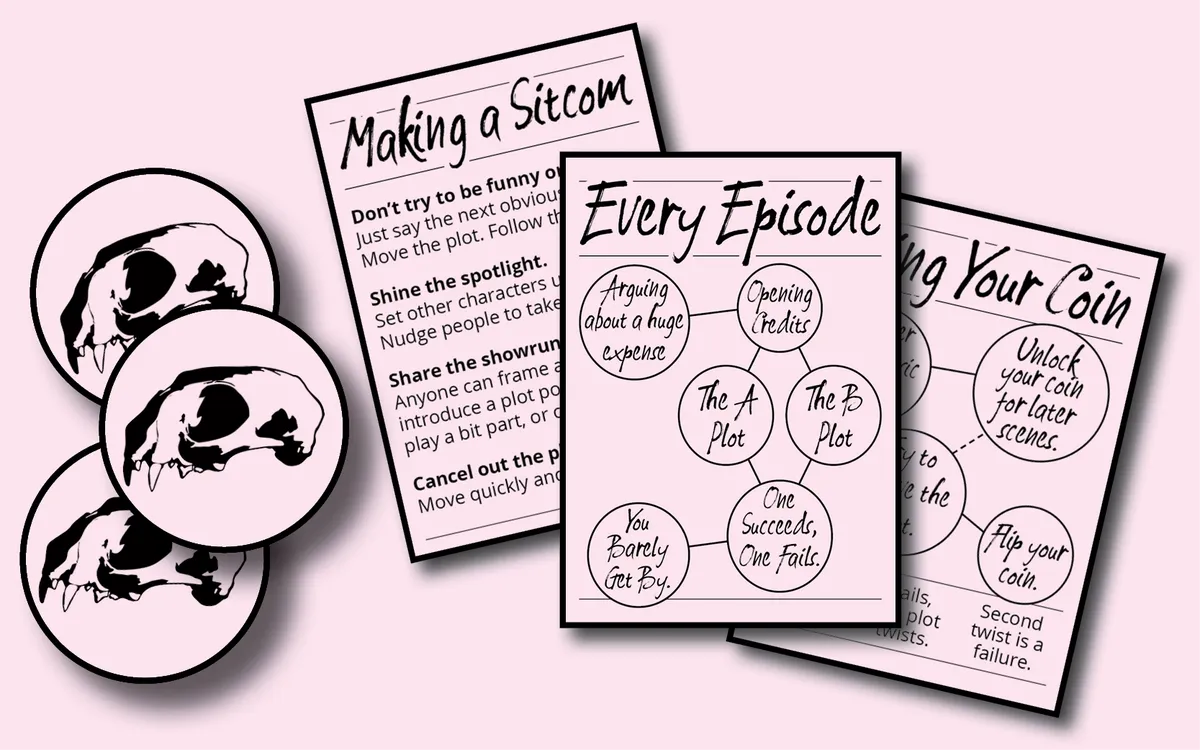
But the really good bit? The thing that stands out to me and that I will talk the ear off anyone willing to listen to me talk about games? Character introductions. Or as the game calls them: Opening Credits.
The Opening Credits happen after everyone chooses their character, has had a time to read through their character's traits and classic question, and after the opening scene, which is not about characters being introduced but instead about introducing the huge expense and having a disagreement or conversation about how best to find the money before it's too late.1 You play a little of your characters before they're introduced to the other players, and to the non-existent audience at home. And then the Opening Credits play.
You get to describe a little scene, or a single shot, or a frame about and with your chosen housemate, to the tune of any chosen sitcom opening theme (real or invented). And the magic trick that this pulls off is to show the quintessential nature of the characters, in situations that don't have to be connected to each other while still all existing in the same shared space, giving us the driving essence of each character in play for the rest of the session.

Deathmatch Island by Tim Denee pulls a similar trick by introducing Competitors (player characters) to a scene, and then breaking the fourth wall as each player narrates in a "confessional" what happened in the scene retroactively, building on each preceding character's narration, from lowest result to highest.2 What Going for Broke does differently, and perhaps even more successfully,3 is condense the character traits into a distilled experience, for everyone at the table to play with beyond the character's player alone. In a game where everyone has "showrunner" duties and powers, this is a perfect springboard.
One of the players of the games I've facilitated never described their character directly during the Opening Credits, but rather showed him show up in the background of everyone else's moment, stealing something trivial from the scene.4 Which is a. comedy gold, b. an excellent character beat to build on for everyone else at the table: people could discuss him never being around, concerned about where he got money from, wondering what his job was (if he even had one), and why things kept disappearing from the house.
All of that from a three minute montage scene of going around the table and having players describe a single moment that showcased their character (as written on the single card everyone had chosen) in a mundane, everyday scene.
Much like Deathmatch Island with reality TV, Going for Broke evokes, emulates, and builds upon the tropes of the sitcom genre it plays with. It distills rather than simplifies, it sets up archetypes rather than stereotypes, it teaches players how to tell a fast, cohesive story by encouraging everyone to chip in, and it does so from the very first moment of play.
And of course, every episode ends the same way: with the roommates barely getting by.
Going for Broke can be found at the bottom of your purse, or even in your pocket, after you purchase it from Avery Alder's website.
There are other set-ups for the game, but they tend to follow a similar formula even if not the situation proper. A game I facilitated was held in a queer bookshop as a fundraiser, and as I read out the premise of the episode - "A community hub is on the verge of closing its doors because of crushing debt." - I got a warm and fuzzy "Oh, fuck you!" from the owner at the front. I have been assured we're still friends.↩
For more on DMI, I recommend this review from Gemelli, who facilitated my first game of it.↩
Towards the end of the final draft of this, I was reminded that Denee's next big book, Blades '68, actually makes a very similar suggestion for starting sessions (pp. 247-8), including having the GM spotlight aspects of the setting in between player scenes during the credits.↩
This actually ended up being one of the plot resolutions for the episode, as he sold all that stuff on "the black market" (his words) and raised enough funds to cover our expense.↩